How Much Does It Cost to Hire a Graphic Designer for a Small Business? (2026 Pricing Guide)

A freelance graphic designer typically charges $35 to $110 an hour, or $250 to $4,500 for a single project like a logo or brand identity, depending on experience. Design studios and agencies usually start at $3,000 per project or $75 to $175 an hour. Subscription "unlimited design" services run $499 to $1,200 a month. The right choice depends less on which is cheapest and more on how much design work you actually need on an ongoing basis.
In this article
What does a freelance graphic designer cost?
Freelance rates scale almost entirely with experience. An entry-level freelancer with one to three years behind them typically charges $25 to $45 an hour, and their projects (think: a single logo, a flyer, a set of social graphics) usually land between $250 and $1,000. A mid-level freelancer with three to seven years of experience charges $45 to $110 an hour, with typical projects running $1,000 to $4,500. That's usually the range small businesses should expect for a full brand identity, meaning a logo plus a color palette, type system, and basic templates.
Senior freelancers with seven or more years, or a specialty like UX design ($85 to $150 an hour) or motion design ($75 to $130 an hour), charge $110 to $200 or more an hour. At that level you're paying for someone who solves business problems with design, not just someone who makes things look nice, and their projects often run $5,000 to $20,000 or more. Most small businesses looking for a logo, brand identity, or ongoing marketing materials sit comfortably in the entry to mid-level range.
What do design studios and agencies charge?
A design studio or small agency almost always costs more than an individual freelancer, and that's usually by design. You're paying for a team (a designer, often a project manager, sometimes a strategist) plus the overhead that comes with running a business. Expect a project minimum of $3,000 or more, and hourly rates of $75 to $175. Studios make the most sense for a full rebrand, a coordinated campaign across print and digital, or a website that needs real strategic thinking behind the layout, not just visuals.
For a single logo or a straightforward set of marketing materials, a studio is often more than a small business needs. That's where an independent studio or freelance designer who specializes in small business branding, rather than a large full-service agency, tends to be the better fit: enough experience to do the work well, without the overhead of a ten-person team.
What about "unlimited" subscription design services?
Flat-rate subscription design services have become a real third option. Entry-level plans run $499 to $700 a month, mid-range plans $995 to $1,200, and enterprise plans can run $15,000 or more. In exchange, you get a queue of unlimited design requests, typically with next-day or 48-hour turnaround. The math only works in your favor if you're sending three or four requests a month or more. If you need a logo once and then a flyer twice a year, a subscription will cost you far more than paying a freelancer per project.
DIY vs. freelancer vs. studio vs. subscription: a quick comparison
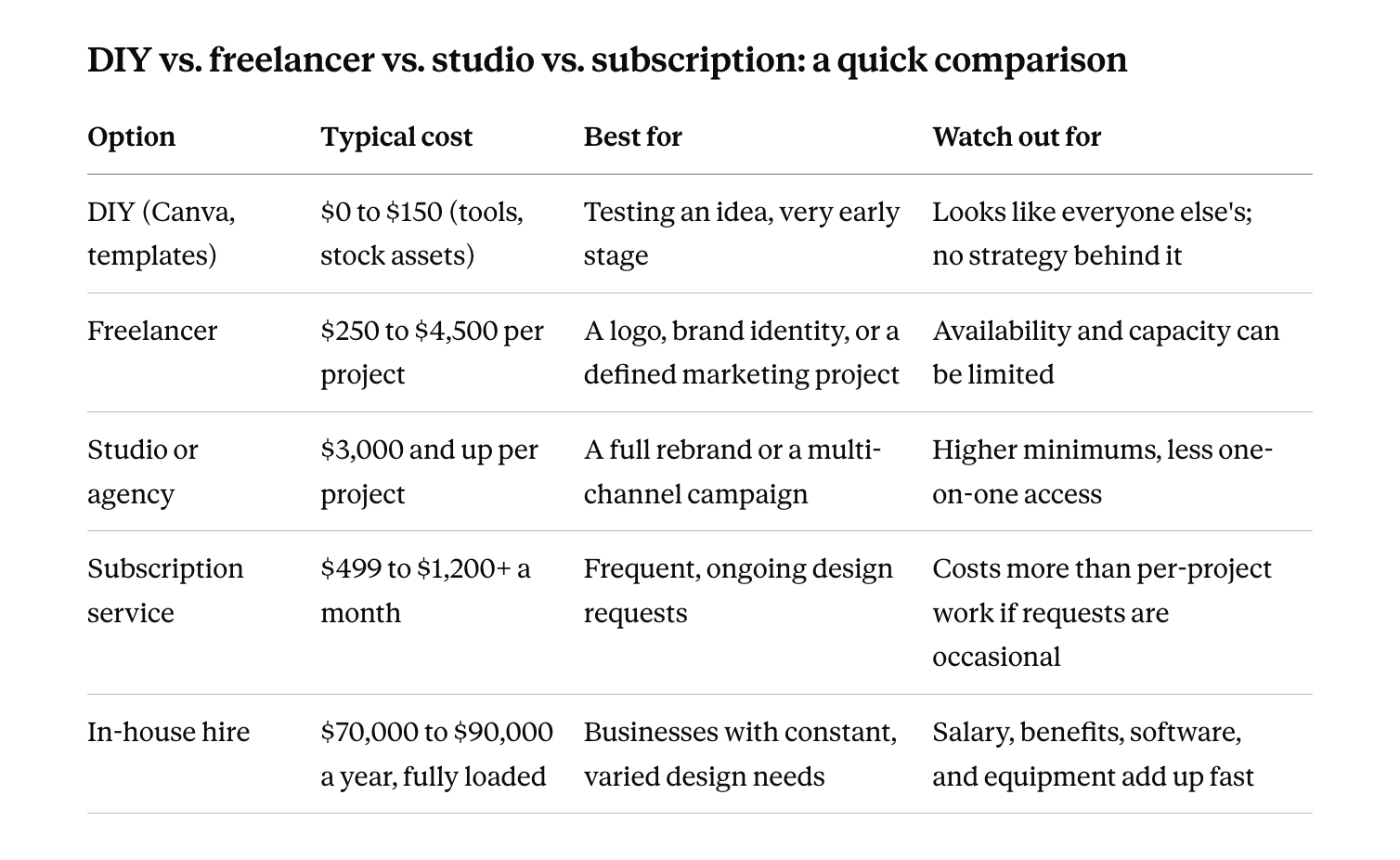
OptionTypical costBest forWatch out forDIY (Canva, templates)$0 to $150 (tools, stock assets)Testing an idea, very early stageLooks like everyone else's; no strategy behind itFreelancer$250 to $4,500 per projectA logo, brand identity, or a defined marketing projectAvailability and capacity can be limitedStudio or agency$3,000 and up per projectA full rebrand or a multi-channel campaignHigher minimums, less one-on-one accessSubscription service$499 to $1,200+ a monthFrequent, ongoing design requestsCosts more than per-project work if requests are occasionalIn-house hire$70,000 to $90,000 a year, fully loadedBusinesses with constant, varied design needsSalary, benefits, software, and equipment add up fast

What actually drives your design costs up or down?
The price you're quoted rarely comes down to raw talent alone. A few concrete things move the number more than anything else: how clear your brief is going in, how many rounds of revisions you expect, your timeline, and whether the project includes print production. A designer who has to guess at your direction, then redo the work twice because expectations weren't set upfront, will charge more, and reasonably so.
Comparison graphic showing factors that keep a graphic design quote lower versus factors that push it higher.
Coming to a first conversation with even a rough brief (your audience, a few competitors or brands you admire, what the piece needs to accomplish) is the single biggest lever you have as a small business owner. It shortens the back and forth, narrows the number of concepts a designer has to produce, and usually shows up as a lower number on the quote.
Brand Identity & Logo Design
Service Spotlight
services/brand-identityBrand Identity & Logo Design
A logo, color palette, type system, and usage guide, scoped to a clear brief from the start.
What are the red flags in a design quote?
A few things are worth watching for before you sign off on any quote, whichever route you choose. A price that's dramatically lower than everything else you've seen usually means fewer revisions, no source files, or work that leans heavily on stock templates. Vague scope (no mention of how many concepts, revisions, or file formats you'll receive) tends to lead to scope creep and surprise add-on fees later. And watch for who owns the final files: a fair quote should be explicit that you own the finished logo and source files once the project is paid in full, not that you're licensing them indefinitely from the designer.
On the other end, a quote with no explanation behind the number, just a flat figure with no breakdown of what's included, makes it hard to compare against anyone else's pricing. Ask for the breakdown. A designer confident in their pricing will walk you through it without hesitation.
How should a small business budget for design?
Most small businesses do best treating design in two buckets. The first is a one-time investment in a solid brand identity: a logo, color palette, and type system that everything else builds on. That's typically a $1,000 to $4,500 project with a freelancer, done once and used for years. The second is an ongoing line item for the materials that keep needing refreshed: seasonal promotions, social graphics, signage, print materials. For that second bucket, compare the cost of occasional per-project work against a subscription service's monthly rate before committing, since the better deal depends entirely on your actual volume, not the sticker price.
As a rule of thumb, budgeting 1 to 3 percent of revenue toward marketing and design in your first few years, then adjusting based on what's actually driving new customers, keeps design spending proportional without letting it become an afterthought.
Frequently asked questions
Is it worth paying a graphic designer for a small business?
For anything customers will see repeatedly, like a logo, signage, or a website, yes. Consistent, professional branding is one of the few marketing investments that keeps paying off years after the initial cost, and a DIY logo is one of the more common things small businesses end up redoing (and paying for twice) once the business starts growing.
How much should a logo cost for a small business in 2026?
Expect $200 to $800 for a standalone logo from a freelancer, or $1,000 to $4,500 if it's bundled into a full brand identity with a color palette and type system, which is usually the better value since a logo alone rarely works well without a system around it.
Should I hire a freelancer or an agency for design work?
A freelancer or small independent studio is typically the better fit for a logo, brand identity, or a defined set of marketing materials. An agency makes more sense for a full rebrand or a coordinated multi-channel campaign that needs strategic planning beyond the visuals themselves.
Do graphic designers charge hourly or by the project?
Both, and it depends on the designer and the work. Most well-defined projects like a logo or a flyer are quoted as a flat project fee. Ongoing or open-ended work, like an evolving campaign, is more often billed hourly or through a monthly retainer.
How much should I budget per month for ongoing design?
If you need design work more than three or four times a month, a subscription service ($499 to $1,200 a month) usually costs less than paying per project. If your needs are occasional, budgeting $300 to $800 a quarter for one-off freelance projects is a reasonable starting point for most small businesses.
Not sure what your own project should cost?
Tell us what you're working on and we'll give you a straight, itemized quote, no surprise fees.
Get a free 20-minute consultation →
No obligation. If we're not the right fit, we'll tell you that too.
Related reading: How to Hire a Graphic Designer for Your Small Business: 7 Questions to Ask and 7 Branding Mistakes Small Businesses Make (and How a Designer Fixes Them). Pricing figures referenced above are 2026 market benchmarks summarized from https://www.manypixels.co/blog/get-a-designer/graphic-design-price 2026 graphic design pricing guide and https://solohourly.com/guides/freelance-graphic-designer-rates